
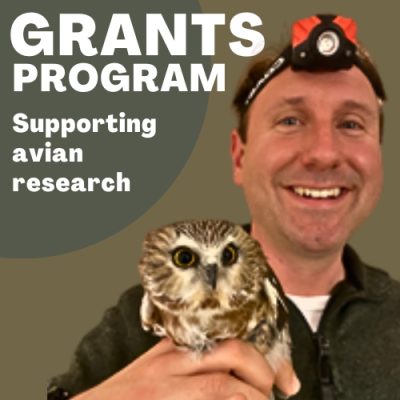
GRANTS PROGRAM
The Illinois Audubon Society Grants Program is returning in 2026. The program was initiated by the Illinois Ornithological Society in 2004 to promote scientific research of birds in Illinois. More than 150 grants totaling greater than $160,000 have been awarded.
Substantial support for the 2026 Grants Program contributed by:
Christine G. Zeman
Elizabeth Crown and Bill Wallace
Illinois Audubon Society is committed to continuing this successful program and is seeking donations to help sustain and grow the amount of funds we are able to award each year. Donations of $1,000 or more will be named as sponsors each year.
CLICK HERE TO SPONSOR the Grants Program
The 2026 Grants online applications will open February 1, 2026
and will close on March 31, 2026.
Awards will be announced in early May.
In 2026, the program is open to student and professional applicants for the following grants. Applicants must choose one level when submitting their application:
-
- One grant of up to $10,000
- Two grants of up to $5,000
- Five grants of up to $2,500
Projects must relate to research on birds while they reside in the geographic boundary of Illinois to qualify. Preference will be given to strong proposals that address at least one of the following:
-
- The conservation and long-term persistence of declining species, those listed under the U.S. Endangered Species Act, or those included on the Illinois List of Endangered and Threatened Fauna
- Focus on data-deficient species (e.g., hard-to-detect or historically understudied species)
- Investigate important unanswered questions in avian biology
Grant recipients must agree to publish an article in an IAS publication. In addition to funding, awardees will receive a free, one-year membership to Illinois Audubon Society.
APPLICATION SUBMISSION DETAILS
Applicants must submit an online application and upload a project proposal (supported file types: .docx or .pdf) by March 31, 2026.
WE WILL BEGIN ACCEPTING APPLICATIONS ON FEBRUARY 1, 2026
Questions? Contact Matt Hayes
2025 Grants Program Awards
(note: 2025 grant awards covered funding up to $2,500)
Michael Avara
University of Illinois at Urbana-Champaign
Amount awarded: $2,500
The stopover and wintering behavior of Northern Saw-whet Owls in Illinois
Tara Beveroth
Illinois Natural History Survey, University of Illinois
Amount awarded: $2,491
Investigating Blood Metabolites in Short- and Long-Distance Migrants in Illinois
Lauren Brunk
University of Illinois Urbana-Champaign
Amount awarded: $2,440
From Breeding to Wintering: Understanding How Demographics, Habitat, Reproduction, and Weather Drive Wood Thrush Activity and Departure
Madison Chudzik
Duke University
Amount awarded: $2,462
Quantifying Migratory Behavior in Response to Artificial Light at Night and Weather
Anant Deshwal
Bradley University
Amount awarded: $2,475
Climate Change induced shift in the migration phenology of partial-migrants
Wendy Dorman
University of Illinois Urbana Champaign
Amount awarded: $2,500
Developing a High-Resolution Dataset to Inform Grassland Bird Management Using Cross-Scale Remote Sensing
Facundo Fernandez-Duque
University of Illinois Urbana-Champaign
Amount awarded: $1,988
Effects of Anthropogenic Noise on Parental Care in Red-winged Blackbirds
Auriel Fournier
Illinois Natural History Survey/Forbes Biological Station
Amount awarded: $2,455
Development of automated processing for recordings to detect King Rails
Lila Fried
Chicago Ornithological Society & Miami University
Amount awarded: $2,500
Using Motus and MAPS to investigate migratory songbird demography in a post-industrial wetland
J’orge Garcia
Windy City Bird Lab
Amount awarded: $2,000
Bringing Parabolic Recording to the Public: Professional Tools for Community Science
Grant Witynski
University of Illinois Urbana-Champaign
Amount awarded: $2,491
Investigating the threat posed by spray drift of common pesticides to one of birds’ most important insect prey groups
Shu-Yueh (Winnie) Liao
University of Illinois Urbana-Champaign
Amount awarded: $2,500
Corridors in the Air: Tracking Nocturnal Migration and Stopover Use Along the Fox River